About This Report
The State of Revenue report is compiled from a series of diagnostic surveys including our Revenue Effectiveness DiagnosticTM and B2B Buyer Survey combined with hundreds of live interviews across Q2 2024 through Q1 2025. The surveys covered 300+ individuals across 72 organizations from multiple industries. Companies varied in size from large multinationals to tech start-ups.
For our Revenue Effectiveness DiagnosticTM specifically, respondents were asked to identify their current priorities. We asked them to allocate investments across the nine categories of activities identified in the model. Then, respondents were asked to assess their company’s effectiveness across three crucial attributes that underpin each category. Our buyer study looked at the perspective of both buyers and sellers around key issues regarding trust, value, and prioritization.
Introduction
“Smile, though your heart is aching” sang Nat “King” Cole based on Charlie Chaplin’s 1936 movie “Modern Times”. The song’s lyrics “Smile and maybe tomorrow/You’ll see the sun come shining through for you” would make a good motto for 2025 as markets churn and the geo-political environment turns febrile. With this potentially being the first policy-driven recession in recent memory, many are uncertain about how to respond. Only one thing is certain, uncertainty is here to stay with the range of possible outcomes having dramatically expanded.
So it’s perhaps no surprise that we see companies looking to de-risk and increase the quality and depth of their customer relationships. One of our clients speaks of an “all weather” strategy.
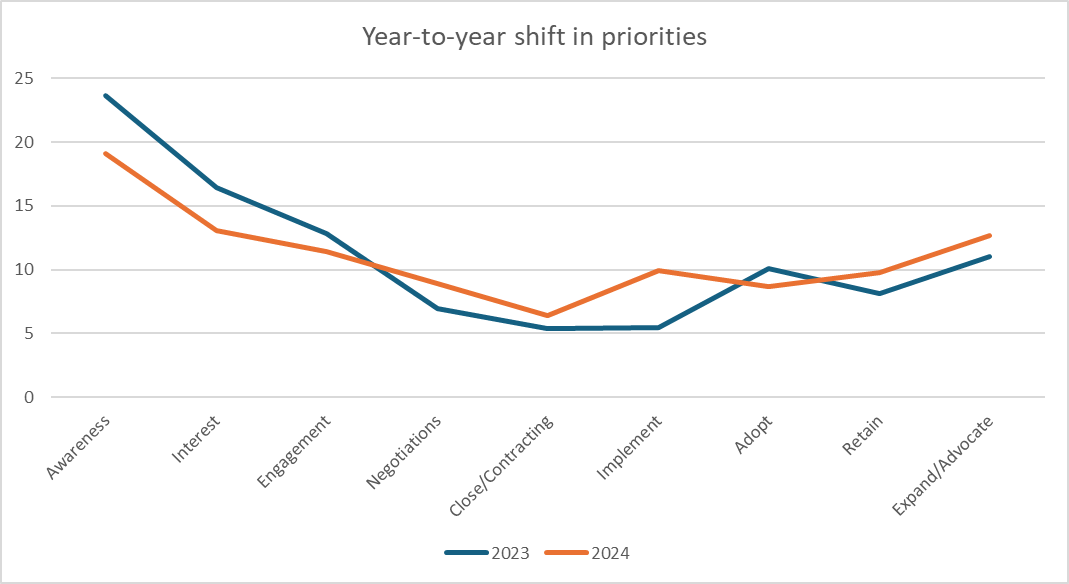
As we see in our data coming from the Revenue Effectiveness DiagnosticTM, awareness building and interest generation are still top challenges for sales leaders, but there’s been a shift in attention toward the later stages of the funnel with more attention being paid to implementation, retention, and expansion.
While it’s natural to want to sell more to those who already buy more from you, we believe that sales organizations need to work on 3 specific gaps to deliver on their commitments:
- We observe a large trust gap between buyers and sellers. It’s not that buyers literally disbelieve what sellers tell them, it’s that they believe that what they’re being sold isn’t as valuable as sellers claim.
- We find that a capability gap lies at the root cause, with sellers frequently failing at two very specific parts of the sales process:
- Well-meaning efforts to help reps prioritize have made discovery and the opportunity management process worse.
- Sales organizations continue to report critical weaknesses around account management capabilities, limiting companies’ efforts to expand beyond their core.
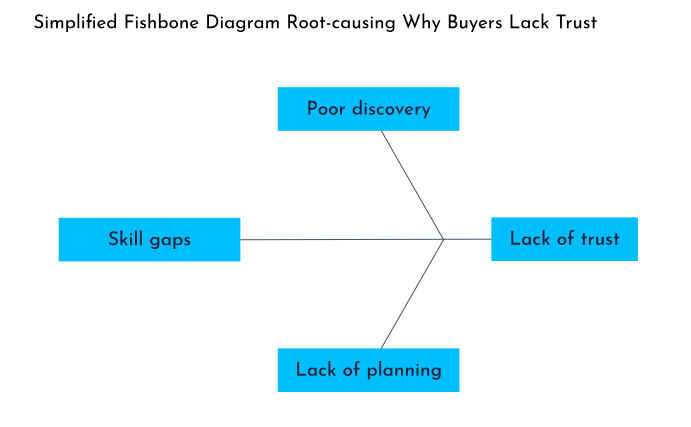
Underlying these gaps are large skill gaps.
The Trust Gap
As interviews with them make clear, buyers are extremely skeptical of promises around ROI and business cases. Few believe that these promises are even somewhat trustworthy. Worryingly, the sales people they interact with share some of the same concerns.
That’s in stark contrast to promises around functionality, performance or even service. Buyers are far more likely to believe these claims.
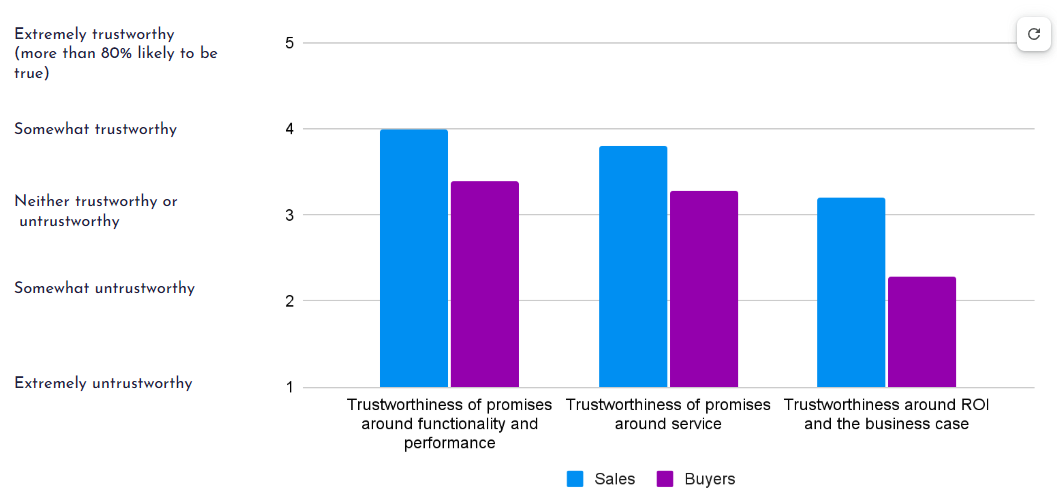
Relative lack of buyer skepticism around functionality and service also explains, we believe, why sellers often revert to pitching features and benefits. It’s simply easier and such pitches are less likely to incur push-back. The problem with this approach, however, is obvious: not addressing questions around ROI forces the buyer to do all the hard work themselves.
A clear-cut solution is to lead buyers towards a conversation where both parties develop an in-depth understanding of where and how value is to be created. Too many sellers fall at the very first hurdle: they’re unable to build a connection that’s based on demonstrating an objective understanding of the buyer’s challenges. Company after company has told us how they find it increasingly difficult to prospect. Ironically, the availability of good automation seems to have only made things worse, with most cold solicitations ending up in people’s spam filters.
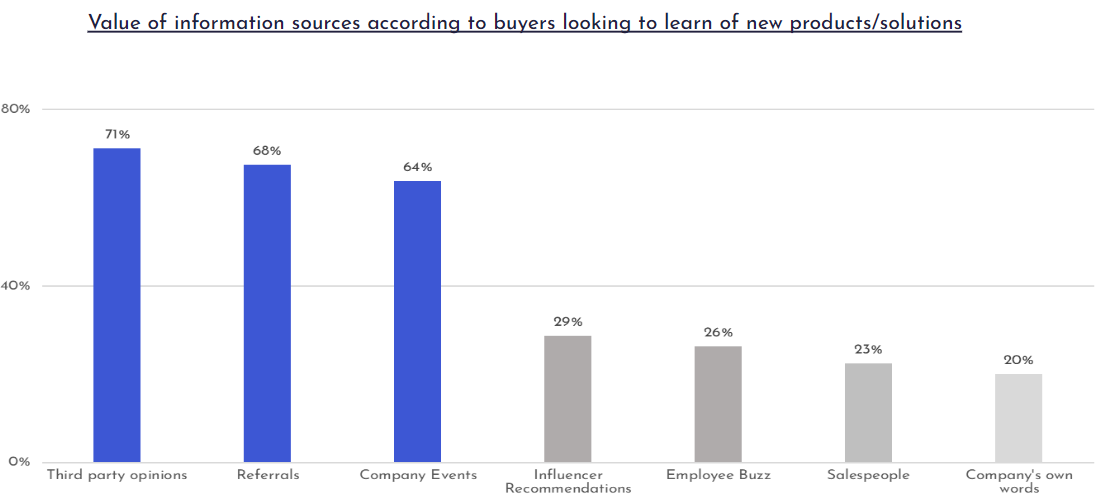
Buyers, on the other hand, have articulated to us how they prefer for sellers to build credibility with them. Buyers report that they’re primarily looking for outside perspectives, ideally from a trusted-third party.
This is where most companies and sellers, we think, miss a trick. They are not making the most of what they’ve learnt from customers. While it is true that hard pitches are poorly received, sellers often have an important opportunity to share wisdom they have acquired working with other companies. So long as the perspective is viewed as honest and relevant it goes a long way to improve the perceived value gained from the relationship.
A related issue is sellers not truly understanding the buying process. At a very basic level, sellers continue to underestimate the number of people involved in a sale.

More fundamentally, we find that sellers often find it hard to look beyond the immediate needs of the people they interact with. Sellers usually have considerable product experience, knowing how to address more obvious functional needs such as security or purchase terms. However, sellers often neglect the strategic dimension of a sale: would a senior-level executive think that the purchase advances or contradicts the company’s strategic goals? For example, we observed that one of our client’s reps frequently did not seek to understand if prospects were open to a strategic outsourcing decision. Failing to have a conversation around outsourcing earlier, they found that many promising deals were being veto-ed by “management.” The antidote was to spend far more time on understanding the buying group and on determining the feasibility of a sale given a prospect’s strategic posture.
The Capability Gaps
The Discovery Gap
One of the more striking findings from our ongoing study of companies is that only 12% of respondents rate their discovery process highly. Most are dissatisfied.
The discovery gap, we believe, is mostly an unintended consequence of wanting to bring rigor to the sales process. Observing that newer team members in particular often spend too much time on non-viable opportunities, we have seen many sales organizations introduce formal qualification tools such as BANT or MEDDIC. While high performers naturally tend to qualify early and often, they typically do this in an organic way that lends to a two-way dialogue around fit and readiness, while teasing out the core criteria of the purchase. Core performers, however, often follow the advice of a standard qualification process a little too literally. We have observed too many sales interactions that start with questions around budget, rigidly following a structured buying process, instead of looking to determine alignment with the prospect’s needs as the seller works their way through a checklist. At a minimum, this makes for a poor experience. As one of our buyers put it: “The worst behavior is asking ‘discovery’ questions at the beginning just to pretend they care about your business…”
Mistaking qualification for discovery means that both parties miss out on the opportunity to identify whether or not there is true alignment between a vendor and a potential customer organization.
Not engaging in a real dialogue with a customer also makes sellers overconfident in their estimate of how well they understand the customer. Fully 45% of participants report that they have fully mastered the customer’s problem. It’s then no surprise that losses are too often ascribed to external factors such as uncertainty or, most often, price, as opposed to the true cause, a lack of alignment in the first place.
The Account Management Gap
For the second year running, respondents to our Revenue Effectiveness Diagnostic singled out account management as one of the biggest single capability gaps with only 7% believing that their sales force excels at this.
In interviews with clients, we observe two big gaps and one big misunderstanding. The big gaps are as follows:
- Most obviously, there is a lack of commitment to measuring whether or not key outcomes were achieved. Worse, we often find that key outcomes were not defined during the purchase. This often means that account managers and CSMs are often on the defensive, looking to retrospectively justify the sale.
- More concerningly, there are often no decision rules around how different parts of the team should come together to grow the business. Account managers often have very little incentive to invite more specialized AEs into their accounts and it’s rare that the Account Managers (or CSMs) themselves have received the training necessary to expand and deepen the relationship.
The big misunderstanding, we believe, is the assumption that the existing relationship should make expansion sales (cross-sales and up-sales) materially easier. The reality is that expansions typically require reaching out to executives who might not be familiar with the solution. Large-scale expansions also start raising red flags with procurement and finance teams who, rightly, start asking whether or not it wouldn’t be cheaper and more effective to spread out a purchase between providers. These teams then often require additional data to make sure that a purchase delivers additional value beyond the immediate use cases. These situations often require more sales resources, not less. Something that mature companies explicitly account for by creating more dedicated key accounts teams.
The Skills Gap
Ultimately, the trust gap can be explained by a persistent skills gap that appears to have gotten worse over time.
When we look at how buyers rate sales skills, we see them rating them high on managing the relationship. No AE will ever agree, but buyers often believe that sellers have the upper hand when it comes to negotiations.
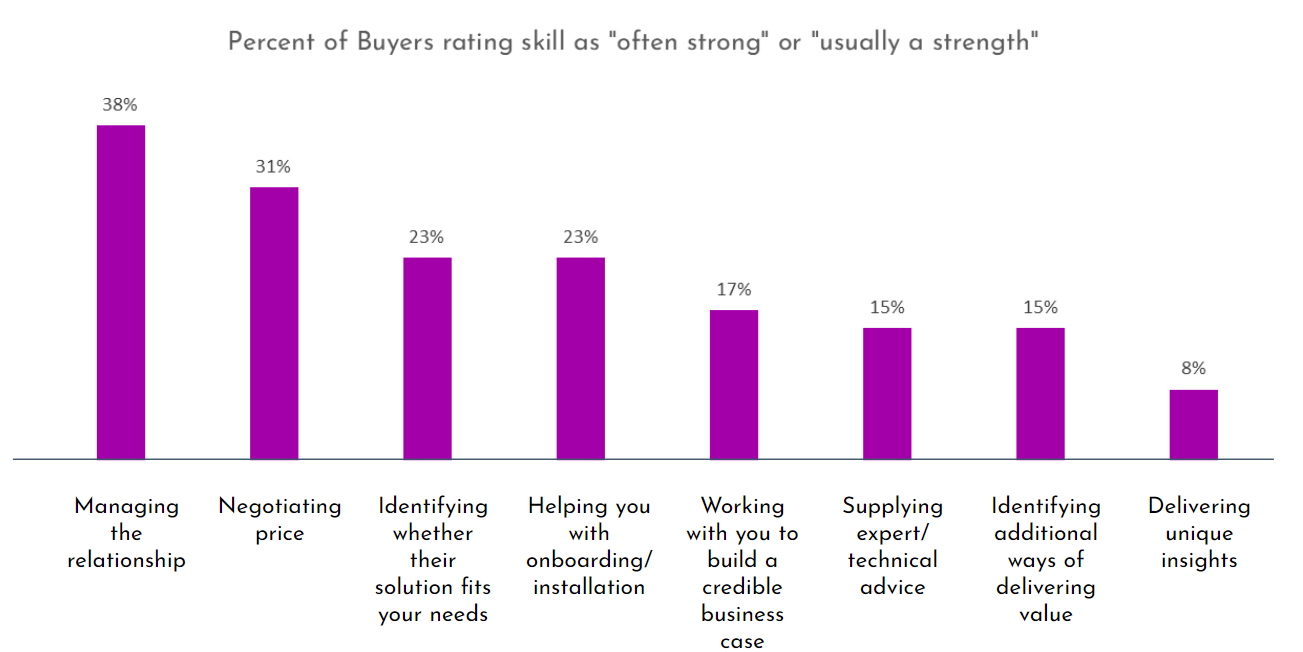
Conversely, buyers are critical of sales’ ability to deliver unique insights. In our work, we find that too many AEs routinely shy away from leading client and prospect conversations with business insights. They worry that they are not true experts in the customer’s business and instead revert back to focusing on their own product.
As we have seen, though to a slightly lesser degree, sales organizations are largely aware of their own gaps. Inward looking assessments of the opportunity/account management process reveal that sellers too are frustrated that they are not working to build a business case or identifying how to deliver additional value to customers.
AI Potential and the (current) reality gap
Recent conversations have tended to focus on the potential for AI to transform sales. And it’s rare that we come across anybody who doesn’t use AI in one form or another:
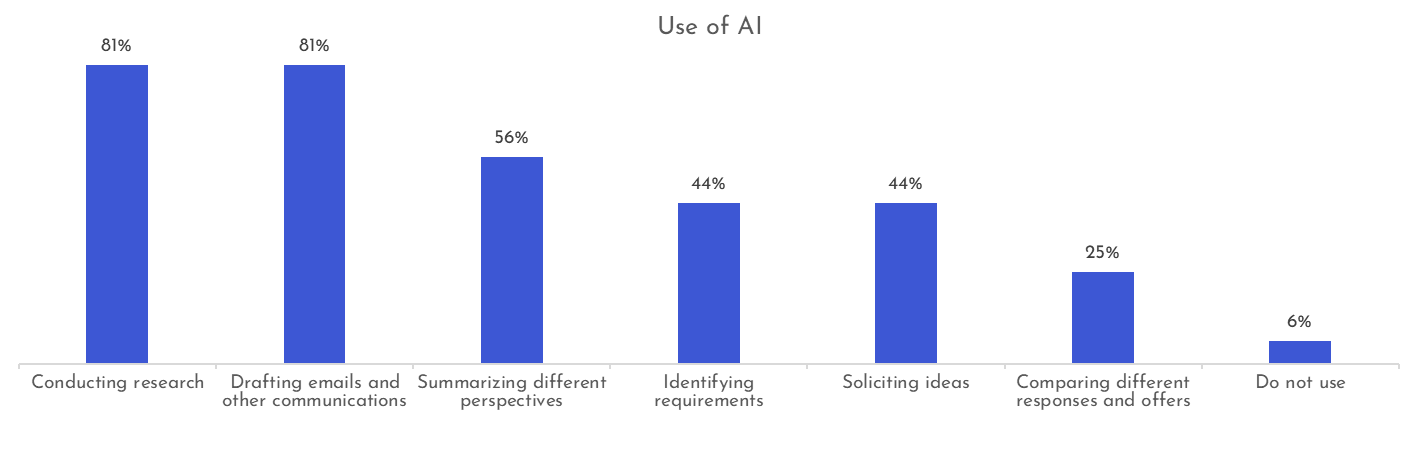
From conversations, we have identified a few main use cases and have an early perspective on how successful these efforts are:
- Using AI for prospecting appears to be a mixed bag. First, there is no doubt that AI makes it easier to conduct research and draft communications. However, the jury is out on whether or not AI can substitute for an outbound motion. Many companies have seen early returns with the use of automation only to realize that while they successfully captured the low hanging fruit during a ‘sprint’, they have also in many cases burned through their market and made their jobs even harder in the future. For the moment, sales conversations remain messy and AI prospecting creates more noise; making it harder for customers to buy, not easier. So we believe that these digital agents have the most potential for simpler purchases, where there really is only one buyer and PLG motions are already dominating. We have not come across anybody successfully scaling fully automated motions to sell more complex offerings.
- AI is making larger inroads into domains where the issue is primarily a lack of knowledge or information. Thus, we are seeing companies successfully bring to life their expertise during the buying process, showing potential to shrink the number of specialists they employ while also potentially improving the customer experience. This could take many forms in the future, everything from a simulated human expert to the use of chatbots to make ‘deal rooms’ more interactive.
- The biggest gains, however, appear to come from using AI to manage tenders, RFPs and implementations. Building on past responses, specialized AI agents are able to dramatically shorten the time it takes to respond to any formal tenders or RFPs. Subsequently, AI can then be used to translate complex requirement documents into code making it easier to fulfill any orders. Structured tasks like this, where an initial draft requires relatively few interactions, appear perfect for AI.
- Not to be forgotten, AI Coaches and Copilots (for everything) seem to be all the rage, but when we poll ICs they overwhelmingly prefer manager and peer-to-peer coaching. These teaching tools seem to work better with the exceptionally self-directed, the kind of person who learns from a book. These tools can provide effective ‘reminders’ to reinforce things reps already fundamentally understand but are not consistently executing. Most people need real-life reinforcement, encouragement and an opportunity to reflect to learn new skills and change behavior.
To summarize, many companies hope that new technologies will quickly solve sales rep deficiencies but we have not seen evidence of improved skills development from these investments unless they are paired with other traditional enablement mechanisms. Too often we hear the opposite: that the introduction of shiny new tools has reduced problem solving skills, reduced the amount of knowledge people have, and that the tools have further shifted attention away from the customer.
Sales people themselves get more excited about AI eliminating manual tasks like CRM entry and data analytics, but they also fear having to adopt yet another tool. Getting the balance right will be key for companies trying to ensure their AI investments live up to their promises.
Conclusions
“Trust is a verb,” a senior executive told us. “It’s something you do, something that builds over time. That’s why asking somebody to simply trust you doesn’t work”.
Our data demonstrates that we need to internalize this principle and identify how to build trust with buyers. Depending on the maturity of the company, buyers aren’t going to have too many questions about the product or service. They realize that plenty of other people have been on that same journey.
But they will have questions around whether or not this is the right solution for them. They don’t want to pay too much for a solution that appears to do the same thing. And the reality is that lower cost competitors often claim the same things.
For the customer to experience trust, sellers need to close the critical gaps identified:
- At the very beginning of the process, sellers need to overcome their reluctance to lead with hypotheses around the customer’s needs. The reluctance is understandable, the odds are that you’ll never be entirely correct. But to not even try risks an entirely reactive approach to sales. But they can only do this with the right tools and the right methodology.
- Ultimately, sellers and buyers need to collaborate on a plan on how value will be delivered. These plans can’t rely on case studies from other customers; those will often be dismissed as being unrealistic. Instead, both parties need a method to identify the gaps, the barriers that stand in the way, and then an evaluation of the economic value that the proposed solution will deliver.
- At the organizational level, companies need to take a change management approach to closing these gaps. Simply walking people through what is expected of them will result in enthusiast head nodding but often little else.
Insight Revenue Recommendations
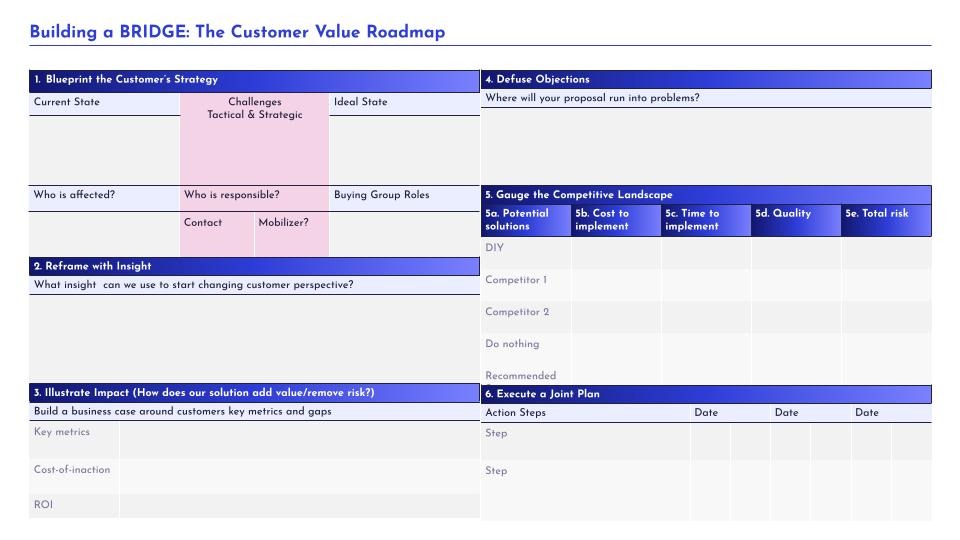
The research is clear on the topic, high performers routinely spend more time on planning and workshopping the sale. They often share their plans with buyers to help them think through what they will need to make a purchase happen. They build a B.R.I.D.G.E. from the customer’s current state to the ideal state and align their solution as a key agent of the change..
Insight Revenue’s solution - B.R.I.D.G.E - is based on work done by purchasers at enterprises looking to compare and prioritize possible investments. We believe that sellers can use the same framework, and ask themselves some of the same hard questions, to understand how to best collaborate with their customers and to understand the change burden.
Our experience with working with teams on these plans is that the groundwork needs to be carefully prepared. While high performers typically need little support to operationalize these plans, most sellers will need training and coaching before they are ready to have these kinds of more strategic conversations with their customers.
Download the free resource


About This Report
The State of Revenue report is compiled from a series of diagnostic surveys including our Revenue Effectiveness DiagnosticTM and B2B Buyer Survey combined with hundreds of live interviews across Q2 2024 through Q1 2025. The surveys covered 300+ individuals across 72 organizations from multiple industries. Companies varied in size from large multinationals to tech start-ups.
For our Revenue Effectiveness DiagnosticTM specifically, respondents were asked to identify their current priorities. We asked them to allocate investments across the nine categories of activities identified in the model. Then, respondents were asked to assess their company’s effectiveness across three crucial attributes that underpin each category. Our buyer study looked at the perspective of both buyers and sellers around key issues regarding trust, value, and prioritization.
Introduction
“Smile, though your heart is aching” sang Nat “King” Cole based on Charlie Chaplin’s 1936 movie “Modern Times”. The song’s lyrics “Smile and maybe tomorrow/You’ll see the sun come shining through for you” would make a good motto for 2025 as markets churn and the geo-political environment turns febrile. With this potentially being the first policy-driven recession in recent memory, many are uncertain about how to respond. Only one thing is certain, uncertainty is here to stay with the range of possible outcomes having dramatically expanded.
So it’s perhaps no surprise that we see companies looking to de-risk and increase the quality and depth of their customer relationships. One of our clients speaks of an “all weather” strategy.
As we see in our data coming from the Revenue Effectiveness DiagnosticTM, awareness building and interest generation are still top challenges for sales leaders, but there’s been a shift in attention toward the later stages of the funnel with more attention being paid to implementation, retention, and expansion.
While it’s natural to want to sell more to those who already buy more from you, we believe that sales organizations need to work on 3 specific gaps to deliver on their commitments:
- We observe a large trust gap between buyers and sellers. It’s not that buyers literally disbelieve what sellers tell them, it’s that they believe that what they’re being sold isn’t as valuable as sellers claim.
- We find that a capability gap lies at the root cause, with sellers frequently failing at two very specific parts of the sales process:
- Well-meaning efforts to help reps prioritize have made discovery and the opportunity management process worse.
- Sales organizations continue to report critical weaknesses around account management capabilities, limiting companies’ efforts to expand beyond their core.
Underlying these gaps are large skill gaps.
The Trust Gap
As interviews with them make clear, buyers are extremely skeptical of promises around ROI and business cases. Few believe that these promises are even somewhat trustworthy. Worryingly, the sales people they interact with share some of the same concerns.
That’s in stark contrast to promises around functionality, performance or even service. Buyers are far more likely to believe these claims.
Relative lack of buyer skepticism around functionality and service also explains, we believe, why sellers often revert to pitching features and benefits. It’s simply easier and such pitches are less likely to incur push-back. The problem with this approach, however, is obvious: not addressing questions around ROI forces the buyer to do all the hard work themselves.
A clear-cut solution is to lead buyers towards a conversation where both parties develop an in-depth understanding of where and how value is to be created. Too many sellers fall at the very first hurdle: they’re unable to build a connection that’s based on demonstrating an objective understanding of the buyer’s challenges. Company after company has told us how they find it increasingly difficult to prospect. Ironically, the availability of good automation seems to have only made things worse, with most cold solicitations ending up in people’s spam filters.
Buyers, on the other hand, have articulated to us how they prefer for sellers to build credibility with them. Buyers report that they’re primarily looking for outside perspectives, ideally from a trusted-third party.
This is where most companies and sellers, we think, miss a trick. They are not making the most of what they’ve learnt from customers. While it is true that hard pitches are poorly received, sellers often have an important opportunity to share wisdom they have acquired working with other companies. So long as the perspective is viewed as honest and relevant it goes a long way to improve the perceived value gained from the relationship.
A related issue is sellers not truly understanding the buying process. At a very basic level, sellers continue to underestimate the number of people involved in a sale.
More fundamentally, we find that sellers often find it hard to look beyond the immediate needs of the people they interact with. Sellers usually have considerable product experience, knowing how to address more obvious functional needs such as security or purchase terms. However, sellers often neglect the strategic dimension of a sale: would a senior-level executive think that the purchase advances or contradicts the company’s strategic goals? For example, we observed that one of our client’s reps frequently did not seek to understand if prospects were open to a strategic outsourcing decision. Failing to have a conversation around outsourcing earlier, they found that many promising deals were being veto-ed by “management.” The antidote was to spend far more time on understanding the buying group and on determining the feasibility of a sale given a prospect’s strategic posture.
The Capability Gaps
The Discovery Gap
One of the more striking findings from our ongoing study of companies is that only 12% of respondents rate their discovery process highly. Most are dissatisfied.
The discovery gap, we believe, is mostly an unintended consequence of wanting to bring rigor to the sales process. Observing that newer team members in particular often spend too much time on non-viable opportunities, we have seen many sales organizations introduce formal qualification tools such as BANT or MEDDIC. While high performers naturally tend to qualify early and often, they typically do this in an organic way that lends to a two-way dialogue around fit and readiness, while teasing out the core criteria of the purchase. Core performers, however, often follow the advice of a standard qualification process a little too literally. We have observed too many sales interactions that start with questions around budget, rigidly following a structured buying process, instead of looking to determine alignment with the prospect’s needs as the seller works their way through a checklist. At a minimum, this makes for a poor experience. As one of our buyers put it: “The worst behavior is asking ‘discovery’ questions at the beginning just to pretend they care about your business…”
Mistaking qualification for discovery means that both parties miss out on the opportunity to identify whether or not there is true alignment between a vendor and a potential customer organization.
Not engaging in a real dialogue with a customer also makes sellers overconfident in their estimate of how well they understand the customer. Fully 45% of participants report that they have fully mastered the customer’s problem. It’s then no surprise that losses are too often ascribed to external factors such as uncertainty or, most often, price, as opposed to the true cause, a lack of alignment in the first place.
The Account Management Gap
For the second year running, respondents to our Revenue Effectiveness Diagnostic singled out account management as one of the biggest single capability gaps with only 7% believing that their sales force excels at this.
In interviews with clients, we observe two big gaps and one big misunderstanding. The big gaps are as follows:
- Most obviously, there is a lack of commitment to measuring whether or not key outcomes were achieved. Worse, we often find that key outcomes were not defined during the purchase. This often means that account managers and CSMs are often on the defensive, looking to retrospectively justify the sale.
- More concerningly, there are often no decision rules around how different parts of the team should come together to grow the business. Account managers often have very little incentive to invite more specialized AEs into their accounts and it’s rare that the Account Managers (or CSMs) themselves have received the training necessary to expand and deepen the relationship.
The big misunderstanding, we believe, is the assumption that the existing relationship should make expansion sales (cross-sales and up-sales) materially easier. The reality is that expansions typically require reaching out to executives who might not be familiar with the solution. Large-scale expansions also start raising red flags with procurement and finance teams who, rightly, start asking whether or not it wouldn’t be cheaper and more effective to spread out a purchase between providers. These teams then often require additional data to make sure that a purchase delivers additional value beyond the immediate use cases. These situations often require more sales resources, not less. Something that mature companies explicitly account for by creating more dedicated key accounts teams.
The Skills Gap
Ultimately, the trust gap can be explained by a persistent skills gap that appears to have gotten worse over time.
When we look at how buyers rate sales skills, we see them rating them high on managing the relationship. No AE will ever agree, but buyers often believe that sellers have the upper hand when it comes to negotiations.
Conversely, buyers are critical of sales’ ability to deliver unique insights. In our work, we find that too many AEs routinely shy away from leading client and prospect conversations with business insights. They worry that they are not true experts in the customer’s business and instead revert back to focusing on their own product.
As we have seen, though to a slightly lesser degree, sales organizations are largely aware of their own gaps. Inward looking assessments of the opportunity/account management process reveal that sellers too are frustrated that they are not working to build a business case or identifying how to deliver additional value to customers.
AI Potential and the (current) reality gap
Recent conversations have tended to focus on the potential for AI to transform sales. And it’s rare that we come across anybody who doesn’t use AI in one form or another:
From conversations, we have identified a few main use cases and have an early perspective on how successful these efforts are:
- Using AI for prospecting appears to be a mixed bag. First, there is no doubt that AI makes it easier to conduct research and draft communications. However, the jury is out on whether or not AI can substitute for an outbound motion. Many companies have seen early returns with the use of automation only to realize that while they successfully captured the low hanging fruit during a ‘sprint’, they have also in many cases burned through their market and made their jobs even harder in the future. For the moment, sales conversations remain messy and AI prospecting creates more noise; making it harder for customers to buy, not easier. So we believe that these digital agents have the most potential for simpler purchases, where there really is only one buyer and PLG motions are already dominating. We have not come across anybody successfully scaling fully automated motions to sell more complex offerings.
- AI is making larger inroads into domains where the issue is primarily a lack of knowledge or information. Thus, we are seeing companies successfully bring to life their expertise during the buying process, showing potential to shrink the number of specialists they employ while also potentially improving the customer experience. This could take many forms in the future, everything from a simulated human expert to the use of chatbots to make ‘deal rooms’ more interactive.
- The biggest gains, however, appear to come from using AI to manage tenders, RFPs and implementations. Building on past responses, specialized AI agents are able to dramatically shorten the time it takes to respond to any formal tenders or RFPs. Subsequently, AI can then be used to translate complex requirement documents into code making it easier to fulfill any orders. Structured tasks like this, where an initial draft requires relatively few interactions, appear perfect for AI.
- Not to be forgotten, AI Coaches and Copilots (for everything) seem to be all the rage, but when we poll ICs they overwhelmingly prefer manager and peer-to-peer coaching. These teaching tools seem to work better with the exceptionally self-directed, the kind of person who learns from a book. These tools can provide effective ‘reminders’ to reinforce things reps already fundamentally understand but are not consistently executing. Most people need real-life reinforcement, encouragement and an opportunity to reflect to learn new skills and change behavior.
To summarize, many companies hope that new technologies will quickly solve sales rep deficiencies but we have not seen evidence of improved skills development from these investments unless they are paired with other traditional enablement mechanisms. Too often we hear the opposite: that the introduction of shiny new tools has reduced problem solving skills, reduced the amount of knowledge people have, and that the tools have further shifted attention away from the customer.
Sales people themselves get more excited about AI eliminating manual tasks like CRM entry and data analytics, but they also fear having to adopt yet another tool. Getting the balance right will be key for companies trying to ensure their AI investments live up to their promises.
Conclusions
“Trust is a verb,” a senior executive told us. “It’s something you do, something that builds over time. That’s why asking somebody to simply trust you doesn’t work”.
Our data demonstrates that we need to internalize this principle and identify how to build trust with buyers. Depending on the maturity of the company, buyers aren’t going to have too many questions about the product or service. They realize that plenty of other people have been on that same journey.
But they will have questions around whether or not this is the right solution for them. They don’t want to pay too much for a solution that appears to do the same thing. And the reality is that lower cost competitors often claim the same things.
For the customer to experience trust, sellers need to close the critical gaps identified:
- At the very beginning of the process, sellers need to overcome their reluctance to lead with hypotheses around the customer’s needs. The reluctance is understandable, the odds are that you’ll never be entirely correct. But to not even try risks an entirely reactive approach to sales. But they can only do this with the right tools and the right methodology.
- Ultimately, sellers and buyers need to collaborate on a plan on how value will be delivered. These plans can’t rely on case studies from other customers; those will often be dismissed as being unrealistic. Instead, both parties need a method to identify the gaps, the barriers that stand in the way, and then an evaluation of the economic value that the proposed solution will deliver.
- At the organizational level, companies need to take a change management approach to closing these gaps. Simply walking people through what is expected of them will result in enthusiast head nodding but often little else.
Insight Revenue Recommendations
The research is clear on the topic, high performers routinely spend more time on planning and workshopping the sale. They often share their plans with buyers to help them think through what they will need to make a purchase happen. They build a B.R.I.D.G.E. from the customer’s current state to the ideal state and align their solution as a key agent of the change..
Insight Revenue’s solution - B.R.I.D.G.E - is based on work done by purchasers at enterprises looking to compare and prioritize possible investments. We believe that sellers can use the same framework, and ask themselves some of the same hard questions, to understand how to best collaborate with their customers and to understand the change burden.
Our experience with working with teams on these plans is that the groundwork needs to be carefully prepared. While high performers typically need little support to operationalize these plans, most sellers will need training and coaching before they are ready to have these kinds of more strategic conversations with their customers.