

Selling to Human Resources 2025
About this Report
This report is based on Insight Revenue’s extensive sales research and direct experience working with clients that sell to Human Resources (HR). We owe a special thank you to Nicole Crowley at RedBud HR for feedback and insights. The primary author of the report, Timur Hicyilmaz, is recognized globally for decades of groundbreaking research on sales performance and customer loyalty. He was formerly the head of sales research for CEB now Gartner and Challenger and continues his innovative work as Co-Founder of Insight Revenue.
This white paper explores how sales professionals can effectively engage HR buyers, a group with influence across many organizational purchases. HR professionals juggle responsibilities ranging from employee relations to DEIB initiatives while managing decisions on systems and benefits that affect the entire company. Despite appearing constrained, HR wields significant decision-making authority, and sellers who misread this risk alienating their buyers.
The report identifies three practices that distinguish successful sales approaches:
1. Overweighting Discovery
Too often, sellers make assumptions about HR’s limited power or rush to other decision makers. Instead, effective sellers slow down and build alignment, focusing early conversations on understanding context and framing the buyer’s journey from current state (A) to desired outcome (B). Gentle open-ended questions about organizational needs, past buying processes, and challenges help HR articulate value and strengthen trust.
2. Helping HR Gain Influence
As service providers within their companies, HR leaders seek internal support for their decisions. Sellers can empower them by offering materials, financial framing, and stakeholder-specific insights. Key stakeholders include finance (focused on cost control, especially benefits), compliance (legal, IT, security), procurement (final contracting authority), business leaders (driving growth, cost, or risk priorities), and employees (end users). Anticipating objections and tailoring value messaging to these groups is essential.
3. Enabling Great Service
HR professionals are highly accountable for vendor performance. While strong service builds loyalty, sellers must balance responsiveness with maintaining a strategic advisory role. The best account executives position themselves as advocates who orchestrate support, rather than becoming service desk extensions.
Conclusion
Selling to HR demands patience, alignment, and professionalism. Sellers succeed by investing deeply in discovery, supporting HR’s influence with stakeholders, and managing service expectations. By building trust and implementation clarity early, vendors can help HR deliver measurable organizational impact while strengthening long-term partnerships.
Introduction
HR leaders wear more hats than most. The Society for Human Resource Management (SHRM), for example, identifies 16 practice areas: everything from ‘Leadership and manager development’ to ‘Labor and employee relations’. These bland labels, however, can fail to provide a sense for what it feels like to be an HR professional.
Was somebody not paid on time? That’s for HR. Do hiring managers struggle to fill empty seats? That’s for HR. Did an employee do something they shouldn’t have? Well, HR handles that too.
It only gets worse: as a service provider to the rest of the organization, HR professionals have many responsibilities but can appear to control relatively little. Diversity, Equity, Inclusion & Belonging (DEIB) initiatives illustrate the challenge well. Often implemented at haste during the pandemic, they are now, at a minimum, often being repositioned, with HR hearing it from all sides. It’s no wonder that HR executives can seem beleaguered, especially given that the average US company only has 1.7 HR employees per 100 employees, with larger companies typically employing a proportionately smaller number of HR professionals.
That said, HR is involved in a dizzying number of purchases: everything from deciding the company’s Applicant Tracking System to selecting which health care plan to offer. These are purchases with a wide reach and many people will want to chime in to have their voices heard, even if HR makes the final decision.
This white paper discusses some of the best ways in which we have seen companies support HR professionals through the buying process. Specifically, we have seen sales professionals succeed by providing leverage across three dimensions:
- They overweight discovery
- They help their contact achieve influence across their own organization
- They make themselves accountable (but not responsible) for providing service
Overweighting Discovery
It’s an old riddle: ”a father and son are in a horrible car crash that kills the dad. The son is rushed to the hospital; just as he’s about to go under the knife, the surgeon says, “I can’t operate—that boy is my son!””
These days, few will struggle to identify that the surgeon is most likely to be the boy’s mother but the point is that it’s easy to make the wrong assumption when selling to HR. For example, it might be true that finance needs to become involved at some point. But there’s also nothing unusual about a head of department needing to work with finance. The risk here is that lazy assumptions come across as disrespectful and that a sale is lost due to a poor experience.
Very specifically, we consistently observe salespeople underestimate HR’s power to operate within their mandate. It’s easy to read a desire to obtain broad buy-in across the company as lacking in decision-making authority. This makes it tempting to shortcut this process by going over HR to a different decision maker. But this kind of run around is usually a mistake. A better strategy is to involve HR in the process and to develop a firm understanding of where the need comes from. The challenge is to make sure that the problem isn’t solved before there is alignment.
We recommend that the first call or meeting is spent building out a short story. The trick is to go from “you want X, we have the best X” to something along the lines of “you want to achieve B, you are starting at A, and here are some of the things that are likely making it hard for you to get to B.” The best sellers do not start talking about their products, the X in question, until the end is clear.
More open-ended, gentler questions help understand the context:
- Start by asking, “can you tell me a little about why you took the call?” And it’s OK to ask somebody to expand on their answer. Listening is key.
- Follow-up by asking them a little about the organization. Clarifying that you want to make the best recommendation for them. Most people enjoy talking about where they work.
Instead of literally asking about the purchase process, ask “what happened last time you bought something like this?”, chances are the company’s internal processes are reasonably consistent and this avoids awkward questions about a sign-off process.
Helping your HR buyer gain influence
As providers of a service to the entire organization, HR is only too aware of the risk of getting it wrong. Accomplished HR professionals minimize risk by running careful processes which sellers often find frustrating. Instead of trying to force the sale through, we recommend simply asking: “how can I help you support this purchase internally?” and then waiting for the answer.
While the precise list of stakeholders varies by product and company, the following personas will often need to be consulted:
- Finance always looms over any purchases with the economic uncertainties of 2025 only reinforcing finance’s tendency to want to control purchasing. Finance’s involvement will be especially strong for some of the largest purchases that HR is involved in: anything involving health care and benefits. In the US, constantly rising health care costs have focused attention on this spend. Sellers will benefit by helping HR show how they are working to constrain spend.
More generally, like other non-finance focused executives, HR professionals sometimes struggle to speak finance’s language. The best sellers work with their champions to identify how their solution can help the company make money, save money or reduce risk. They help them write emails and proactively offer support.
- The increased digitalization of HR means that Compliance (a combination of legal, IT security, IT, and others) will be part of the conversation. At the risk of oversimplification, sellers are served well by learning a few things ahead of time, such as whether or not a company’s website mentions things such as SOC2 compliance, or whether a company is biased towards all-in-one vs best-of-breed systems. Not knowing where you stand can mean the sale falling apart at the very last minute.
- At the largest companies, Procurement is bound to be involved sooner or later and will orchestrate the final stages of any purchase, wanting to ensure compliance and mitigate potential risks.
Sellers cannot afford to be naive about what’s going to come next. If they anticipate any roadblocks based on what they’ve seen elsewhere, they need to raise them sooner rather than later. Procurement has incentive to postpone or even to cancel any purchases and so won’t be willing to go to bat for anything that isn’t crucial to the business’ ongoing operations. Similarly, sellers need to identify some concessions early on to provide procurement with some easily quantifiable wins during the contracting process.
- When working with companies selling into HR, we also often hear that the deal was stopped by ‘the business’. This is a somewhat disparate group of individuals, often with a General Manager persona. These are the people who most acutely feel the business need and sellers will do well to understand where their offer fits in the company’s strategy:
- Does management want to make the purchase to help them make money? A company in growth mode, for example, will want to make sure that it provides a good candidate experience.
- Does management want the purchase to help them save money or reduce their capital requirements? A company that has recently made many acquisitions will be uniquely open to anything that simplifies their existing systems and processes. A company that is in cost-cutting mode might be interested in any add-ons that permit the buyer to sunset existing solutions.
- Most difficult, does the company want to reduce some of the risks it is exposed to? One concrete way in which sellers can do this, irrespective of product, is to understand how to best structure payment terms and by committing to measurable outcomes that matter to the company.
- Finally, the role of employees should not be underestimated. Here, it’s important to provide a taste for the service and to be ready with referrals and recommendations from peers.
Enabling great service
Given that HR works with everybody at the company, they remain unusually accountable for the things they buy. That’s partly because they often serve as the company’s complaint handling division, tracking and managing engagement. HR can also end up being responsible for what are some very complicated transactions, such as needing to integrate an ATS system or chasing up after a particularly knotty benefits claim.
It’s at these points that HR will want responsive service and look to maintain business with individuals whom they can personally trust. Senior HR people all have a short list of vendors they bring with them from company to company. The conversation often ends up being about the relationship and being there for the customer.
In a sales situation, however, this can be a trap, as time spent on service is time not spent selling. Spending a lot of time on service can also reinforce the buyer’s tendency to see their AE as somebody who mostly resolves problems rather than somebody who provides actionable advice. For some of these reasons, amongst others, we find again and again that while great service drives renewals, it doesn’t translate into growth:
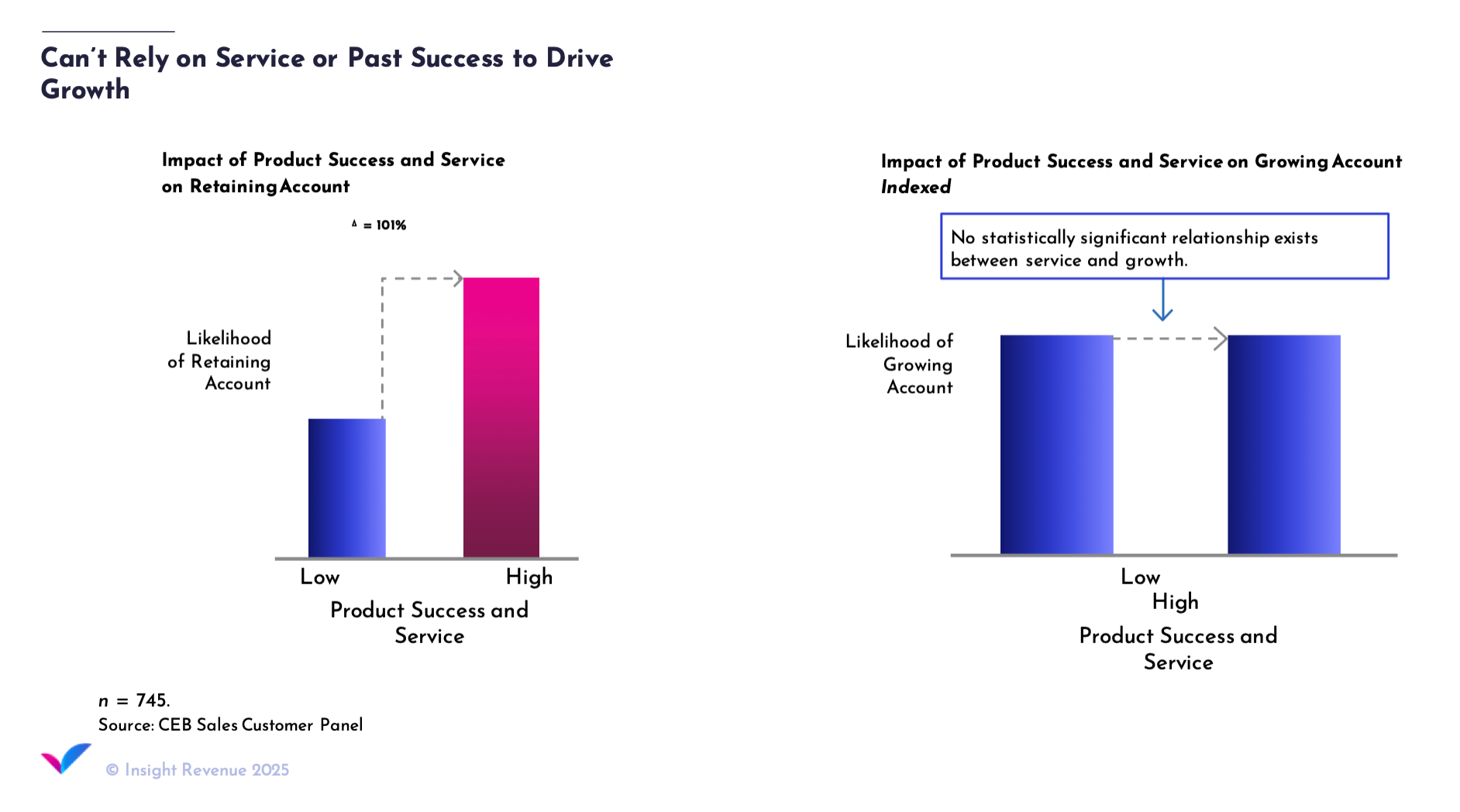
To address this issue, we always recommend that AEs show that they are in control of the service, that they are there to advocate for the customer but not there to personally resolve issues. This is done by bringing the right people together and by staying with the process until there is a resolution, one way or another.
Conclusions
Given HR’s role as an enabler of purchases as well as end-user, we recommend that sellers into HR demonstrate unusual focus on discovery and confidence in implementation rather than the deal. Specifically, this means going slow in the beginning and middle of the sale even though the temptation will be to try and bulldoze to the finish line. This is to ensure that HR is able to tell the right story to each of their internal stakeholders. Ideally, you work with HR to build out an implementation plan long before any deal is negotiated. A more careful and lengthier discovery process than might be immediately apparent is appropriate.
Tactically speaking, we recommend the following:
- Sellers do best by helping HR complete their process. Fighting it rarely works. This means avoiding any surprises and getting the tone right. For example, by leading with an agenda from the very first meeting.
- Similarly, sellers will do well by leaning into HR’s information gathering role. This doesn’t mean sending more information. Instead, it means trying to identify the places where extra information will help address a specific issue.
- It cannot be said often enough, selling into HR requires consideration of other stakeholders. It’s not just about the people who will be making the final decision but also the people who will come in contact with the proposed solution and who will have strong opinions about things that impact their workflows. Again, the best sellers ask HR how they can support them internally. They do not try to second-guess their buyer even as they provide their perspectives on what they have seen work for other companies.
Lastly, careful consideration needs to be given to the fact that HR is often a user of whatever solution is being bought. This puts a premium on professionalism. Your buyer needs to know that somebody is on their side and that they will work hard - usually with a team of experts - to resolve whatever issues might arise.
About Insight Revenue
At Insight Revenue, we're not just another consulting firm. We're an expert enablement partner dedicated to helping companies better understand their buyers, strengthen their relationships, and grow revenue. Our approach is grounded in decades of sales performance research and implementation experience with hundreds of companies worldwide. The founding team were key leaders in building the CEB, Gartner and Challenger sales research and training practices before teaming up to continue their work as Insight Revenue.
We increasingly find that sales teams struggle to effectively connect and collaborate with HR buyers. To address this, we created the ´Insight to Value´ program, a distinct, insight-driven methodology engineered to align your sales approach with the preferences of modern buyers, particularly those in HR.
If the challenges in this whitepaper sound familiar, we know it’s not enough to just tell you what to do; you need a partner who can quickly understand your business and bring proven and scalable approaches to shift behavior and deliver the desired business results.
This is where our global implementation teams come in. We don't believe in generic, one-size-fits-all solutions. We assign a dedicated expert team to work with you to understand your specific market and challenges, and design training and tools that will drive fast and sustainable impact. We can help you:
- Elevate your discovery process: We help your teams develop the skills and strategy to ask the right questions that build trust and uncover the true context of your buyer's situation. We focus on building an understanding of their current challenges and desired outcomes so you can frame the value of your solution in a way that resonates with them.
- Empower your HR champions: We provide a framework to help your HR buyers become more effective internal advocates for your solution. This includes teaching your team how to ´elevate their conversations´ so they can proactively coach and equip champions with the right financial framing, and stakeholder-specific talking points to address the primary concerns of finance, procurement, and business leaders.
- Refine your ´service´ approach: We train your teams on how to balance being responsive with maintaining a forward-looking advisory role. You'll learn to position yourself as an advocate who orchestrates support from your service team, rather than a frontline problem solver. This will gain the confidence of the buying team to explore broader solutions.
Download Full Report Below!
Download the free resource


Selling to Human Resources 2025
About this Report
This report is based on Insight Revenue’s extensive sales research and direct experience working with clients that sell to Human Resources (HR). We owe a special thank you to Nicole Crowley at RedBud HR for feedback and insights. The primary author of the report, Timur Hicyilmaz, is recognized globally for decades of groundbreaking research on sales performance and customer loyalty. He was formerly the head of sales research for CEB now Gartner and Challenger and continues his innovative work as Co-Founder of Insight Revenue.
This white paper explores how sales professionals can effectively engage HR buyers, a group with influence across many organizational purchases. HR professionals juggle responsibilities ranging from employee relations to DEIB initiatives while managing decisions on systems and benefits that affect the entire company. Despite appearing constrained, HR wields significant decision-making authority, and sellers who misread this risk alienating their buyers.
The report identifies three practices that distinguish successful sales approaches:
1. Overweighting Discovery
Too often, sellers make assumptions about HR’s limited power or rush to other decision makers. Instead, effective sellers slow down and build alignment, focusing early conversations on understanding context and framing the buyer’s journey from current state (A) to desired outcome (B). Gentle open-ended questions about organizational needs, past buying processes, and challenges help HR articulate value and strengthen trust.
2. Helping HR Gain Influence
As service providers within their companies, HR leaders seek internal support for their decisions. Sellers can empower them by offering materials, financial framing, and stakeholder-specific insights. Key stakeholders include finance (focused on cost control, especially benefits), compliance (legal, IT, security), procurement (final contracting authority), business leaders (driving growth, cost, or risk priorities), and employees (end users). Anticipating objections and tailoring value messaging to these groups is essential.
3. Enabling Great Service
HR professionals are highly accountable for vendor performance. While strong service builds loyalty, sellers must balance responsiveness with maintaining a strategic advisory role. The best account executives position themselves as advocates who orchestrate support, rather than becoming service desk extensions.
Conclusion
Selling to HR demands patience, alignment, and professionalism. Sellers succeed by investing deeply in discovery, supporting HR’s influence with stakeholders, and managing service expectations. By building trust and implementation clarity early, vendors can help HR deliver measurable organizational impact while strengthening long-term partnerships.
Introduction
HR leaders wear more hats than most. The Society for Human Resource Management (SHRM), for example, identifies 16 practice areas: everything from ‘Leadership and manager development’ to ‘Labor and employee relations’. These bland labels, however, can fail to provide a sense for what it feels like to be an HR professional.
Was somebody not paid on time? That’s for HR. Do hiring managers struggle to fill empty seats? That’s for HR. Did an employee do something they shouldn’t have? Well, HR handles that too.
It only gets worse: as a service provider to the rest of the organization, HR professionals have many responsibilities but can appear to control relatively little. Diversity, Equity, Inclusion & Belonging (DEIB) initiatives illustrate the challenge well. Often implemented at haste during the pandemic, they are now, at a minimum, often being repositioned, with HR hearing it from all sides. It’s no wonder that HR executives can seem beleaguered, especially given that the average US company only has 1.7 HR employees per 100 employees, with larger companies typically employing a proportionately smaller number of HR professionals.
That said, HR is involved in a dizzying number of purchases: everything from deciding the company’s Applicant Tracking System to selecting which health care plan to offer. These are purchases with a wide reach and many people will want to chime in to have their voices heard, even if HR makes the final decision.
This white paper discusses some of the best ways in which we have seen companies support HR professionals through the buying process. Specifically, we have seen sales professionals succeed by providing leverage across three dimensions:
- They overweight discovery
- They help their contact achieve influence across their own organization
- They make themselves accountable (but not responsible) for providing service
Overweighting Discovery
It’s an old riddle: ”a father and son are in a horrible car crash that kills the dad. The son is rushed to the hospital; just as he’s about to go under the knife, the surgeon says, “I can’t operate—that boy is my son!””
These days, few will struggle to identify that the surgeon is most likely to be the boy’s mother but the point is that it’s easy to make the wrong assumption when selling to HR. For example, it might be true that finance needs to become involved at some point. But there’s also nothing unusual about a head of department needing to work with finance. The risk here is that lazy assumptions come across as disrespectful and that a sale is lost due to a poor experience.
Very specifically, we consistently observe salespeople underestimate HR’s power to operate within their mandate. It’s easy to read a desire to obtain broad buy-in across the company as lacking in decision-making authority. This makes it tempting to shortcut this process by going over HR to a different decision maker. But this kind of run around is usually a mistake. A better strategy is to involve HR in the process and to develop a firm understanding of where the need comes from. The challenge is to make sure that the problem isn’t solved before there is alignment.
We recommend that the first call or meeting is spent building out a short story. The trick is to go from “you want X, we have the best X” to something along the lines of “you want to achieve B, you are starting at A, and here are some of the things that are likely making it hard for you to get to B.” The best sellers do not start talking about their products, the X in question, until the end is clear.
More open-ended, gentler questions help understand the context:
- Start by asking, “can you tell me a little about why you took the call?” And it’s OK to ask somebody to expand on their answer. Listening is key.
- Follow-up by asking them a little about the organization. Clarifying that you want to make the best recommendation for them. Most people enjoy talking about where they work.
Instead of literally asking about the purchase process, ask “what happened last time you bought something like this?”, chances are the company’s internal processes are reasonably consistent and this avoids awkward questions about a sign-off process.
Helping your HR buyer gain influence
As providers of a service to the entire organization, HR is only too aware of the risk of getting it wrong. Accomplished HR professionals minimize risk by running careful processes which sellers often find frustrating. Instead of trying to force the sale through, we recommend simply asking: “how can I help you support this purchase internally?” and then waiting for the answer.
While the precise list of stakeholders varies by product and company, the following personas will often need to be consulted:
- Finance always looms over any purchases with the economic uncertainties of 2025 only reinforcing finance’s tendency to want to control purchasing. Finance’s involvement will be especially strong for some of the largest purchases that HR is involved in: anything involving health care and benefits. In the US, constantly rising health care costs have focused attention on this spend. Sellers will benefit by helping HR show how they are working to constrain spend.
More generally, like other non-finance focused executives, HR professionals sometimes struggle to speak finance’s language. The best sellers work with their champions to identify how their solution can help the company make money, save money or reduce risk. They help them write emails and proactively offer support.
- The increased digitalization of HR means that Compliance (a combination of legal, IT security, IT, and others) will be part of the conversation. At the risk of oversimplification, sellers are served well by learning a few things ahead of time, such as whether or not a company’s website mentions things such as SOC2 compliance, or whether a company is biased towards all-in-one vs best-of-breed systems. Not knowing where you stand can mean the sale falling apart at the very last minute.
- At the largest companies, Procurement is bound to be involved sooner or later and will orchestrate the final stages of any purchase, wanting to ensure compliance and mitigate potential risks.
Sellers cannot afford to be naive about what’s going to come next. If they anticipate any roadblocks based on what they’ve seen elsewhere, they need to raise them sooner rather than later. Procurement has incentive to postpone or even to cancel any purchases and so won’t be willing to go to bat for anything that isn’t crucial to the business’ ongoing operations. Similarly, sellers need to identify some concessions early on to provide procurement with some easily quantifiable wins during the contracting process.
- When working with companies selling into HR, we also often hear that the deal was stopped by ‘the business’. This is a somewhat disparate group of individuals, often with a General Manager persona. These are the people who most acutely feel the business need and sellers will do well to understand where their offer fits in the company’s strategy:
- Does management want to make the purchase to help them make money? A company in growth mode, for example, will want to make sure that it provides a good candidate experience.
- Does management want the purchase to help them save money or reduce their capital requirements? A company that has recently made many acquisitions will be uniquely open to anything that simplifies their existing systems and processes. A company that is in cost-cutting mode might be interested in any add-ons that permit the buyer to sunset existing solutions.
- Most difficult, does the company want to reduce some of the risks it is exposed to? One concrete way in which sellers can do this, irrespective of product, is to understand how to best structure payment terms and by committing to measurable outcomes that matter to the company.
- Finally, the role of employees should not be underestimated. Here, it’s important to provide a taste for the service and to be ready with referrals and recommendations from peers.
Enabling great service
Given that HR works with everybody at the company, they remain unusually accountable for the things they buy. That’s partly because they often serve as the company’s complaint handling division, tracking and managing engagement. HR can also end up being responsible for what are some very complicated transactions, such as needing to integrate an ATS system or chasing up after a particularly knotty benefits claim.
It’s at these points that HR will want responsive service and look to maintain business with individuals whom they can personally trust. Senior HR people all have a short list of vendors they bring with them from company to company. The conversation often ends up being about the relationship and being there for the customer.
In a sales situation, however, this can be a trap, as time spent on service is time not spent selling. Spending a lot of time on service can also reinforce the buyer’s tendency to see their AE as somebody who mostly resolves problems rather than somebody who provides actionable advice. For some of these reasons, amongst others, we find again and again that while great service drives renewals, it doesn’t translate into growth:
To address this issue, we always recommend that AEs show that they are in control of the service, that they are there to advocate for the customer but not there to personally resolve issues. This is done by bringing the right people together and by staying with the process until there is a resolution, one way or another.
Conclusions
Given HR’s role as an enabler of purchases as well as end-user, we recommend that sellers into HR demonstrate unusual focus on discovery and confidence in implementation rather than the deal. Specifically, this means going slow in the beginning and middle of the sale even though the temptation will be to try and bulldoze to the finish line. This is to ensure that HR is able to tell the right story to each of their internal stakeholders. Ideally, you work with HR to build out an implementation plan long before any deal is negotiated. A more careful and lengthier discovery process than might be immediately apparent is appropriate.
Tactically speaking, we recommend the following:
- Sellers do best by helping HR complete their process. Fighting it rarely works. This means avoiding any surprises and getting the tone right. For example, by leading with an agenda from the very first meeting.
- Similarly, sellers will do well by leaning into HR’s information gathering role. This doesn’t mean sending more information. Instead, it means trying to identify the places where extra information will help address a specific issue.
- It cannot be said often enough, selling into HR requires consideration of other stakeholders. It’s not just about the people who will be making the final decision but also the people who will come in contact with the proposed solution and who will have strong opinions about things that impact their workflows. Again, the best sellers ask HR how they can support them internally. They do not try to second-guess their buyer even as they provide their perspectives on what they have seen work for other companies.
Lastly, careful consideration needs to be given to the fact that HR is often a user of whatever solution is being bought. This puts a premium on professionalism. Your buyer needs to know that somebody is on their side and that they will work hard - usually with a team of experts - to resolve whatever issues might arise.
About Insight Revenue
At Insight Revenue, we're not just another consulting firm. We're an expert enablement partner dedicated to helping companies better understand their buyers, strengthen their relationships, and grow revenue. Our approach is grounded in decades of sales performance research and implementation experience with hundreds of companies worldwide. The founding team were key leaders in building the CEB, Gartner and Challenger sales research and training practices before teaming up to continue their work as Insight Revenue.
We increasingly find that sales teams struggle to effectively connect and collaborate with HR buyers. To address this, we created the ´Insight to Value´ program, a distinct, insight-driven methodology engineered to align your sales approach with the preferences of modern buyers, particularly those in HR.
If the challenges in this whitepaper sound familiar, we know it’s not enough to just tell you what to do; you need a partner who can quickly understand your business and bring proven and scalable approaches to shift behavior and deliver the desired business results.
This is where our global implementation teams come in. We don't believe in generic, one-size-fits-all solutions. We assign a dedicated expert team to work with you to understand your specific market and challenges, and design training and tools that will drive fast and sustainable impact. We can help you:
- Elevate your discovery process: We help your teams develop the skills and strategy to ask the right questions that build trust and uncover the true context of your buyer's situation. We focus on building an understanding of their current challenges and desired outcomes so you can frame the value of your solution in a way that resonates with them.
- Empower your HR champions: We provide a framework to help your HR buyers become more effective internal advocates for your solution. This includes teaching your team how to ´elevate their conversations´ so they can proactively coach and equip champions with the right financial framing, and stakeholder-specific talking points to address the primary concerns of finance, procurement, and business leaders.
- Refine your ´service´ approach: We train your teams on how to balance being responsive with maintaining a forward-looking advisory role. You'll learn to position yourself as an advocate who orchestrates support from your service team, rather than a frontline problem solver. This will gain the confidence of the buying team to explore broader solutions.
Download Full Report Below!